What Sets the Starting Budget for an Indoor Trampoline Park?
Most indoor trampoline projects run over budget for the same reason: a dozen small costs were never written into one document. Preparing an indoor trampoline park budget plan forces every assumption into the open before the first invoice arrives. Rent, ceiling height, floor loading, power capacity, and fire-exit rules inside an existing building often shape the total as much as the jumping equipment does. Operators who price two or three candidate units against the same attraction list quickly discover that the cheapest lease can demand the most expensive fit-out, because ventilation, reinforcement, and access work all travel with the site. A written budget converts that comparison into numbers the investor can defend.
Where the Money Goes Inside a Trampoline Venue
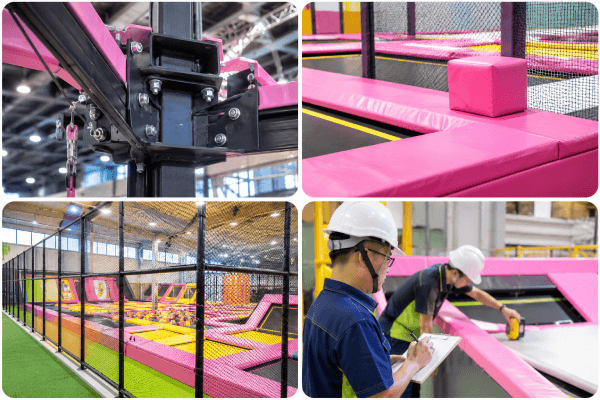
A realistic trampoline park cost breakdown keeps the engineered jumping system separate from everything built around it. The largest equipment line normally covers steel frames, spring beds, perimeter padding, separation netting, and the air bags or foam placed beneath dunk lanes and free-run zones. Around those courts sit the reception desk, lockers, party rooms, seating, restrooms, lighting, sound, and signage, which together can rival the price of the jumping surface itself. Structural surveys, installation labor, freight, spare parts, and certification paperwork belong on the same page rather than in a separate file nobody reviews. When each category carries its own allowance, a quotation that quietly omits one of them is visible immediately instead of three weeks into installation.
How Layout Decisions Change the Final Invoice
Layout decides both what the venue costs and how much it can earn, so those questions should be answered together. Many profitable operators add an indoor soft play structure beside the trampoline courts so toddlers and mixed-age groups have somewhere safe to play while older siblings queue for the main arena. Placing that zone where one supervisor can watch both attractions lowers staffing cost, and putting the cafe beside the entrance invites orders on the way in. Corridors that lead nowhere still carry rent, and blind corners still need extra staff. A plan that keeps sightlines open and removes dead space usually returns the investment faster than one that simply fills the floor with equipment.
Choosing a Supplier Who Protects the Build Budget
Engineering quality is the least glamorous line in the budget and the one that protects all the others. A Miland commercial trampoline park supplier that designs, fabricates, installs, and documents its own attractions gives the operator a single chain of responsibility from drawing to commissioning. Ask whether structural calculations, load ratings, and maintenance schedules arrive with the equipment, because insurers and local inspectors increasingly expect them. Confirm as well what the quoted figure excludes, since freight, customs, site preparation, and commissioning are common gaps that reappear later as change orders. Suppliers who answer those questions in writing before a deposit is paid tend to keep a project close to its original estimate.
Learning From the Wider Trampoline Park Sector
The trampoline park format has matured into a mainstream entertainment category, and that maturity is useful when projecting costs. Published profiles of established venues show how operators combine open jumping, dodgeball, toddler sessions, and fitness classes to keep courts busy outside weekend peaks. That pattern matters to the budget because utilization, not the headline ticket price, decides how quickly capital is repaid. A venue sized for its real catchment area will outperform a larger one that must carry rent for idle courts and maintenance for equipment nobody uses. Studying comparable facilities in the same region gives a new investor benchmarks that no catalogue can provide.
Turning a Cost Estimate Into an Operating Plan
Costs and revenue belong in the same model, so the budget should end with assumptions about turning first-time visitors into repeat guests. Set admission and membership prices from the projected cost per visit, then test them against local wages and competing attractions before signing equipment contracts. Decide which programs, birthday packages, and school sessions will fill weekday mornings, and budget the staff training those programs require. Track spending per head and repeat-booking rates every month, and compare them with the original plan rather than with last season. Every sound trampoline project starts with a documented budget, a layout that supports supervision, and an operating plan written before opening day. Categories: Trampoline Park, Indoor Playground, Family Entertainment Center, Commercial Playground Equipment, FEC Attractions, Business Planning. Tags: trampoline park cost, indoor trampoline park, trampoline park budget, trampoline park construction, family entertainment center, business planning. https://www.milandplay.com/product/trampoline-park-for-sale/
Leave a Reply