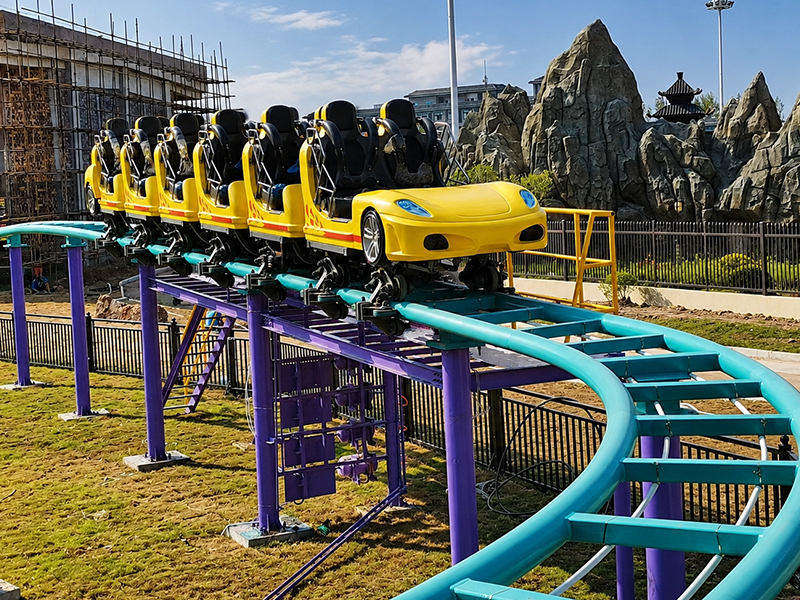
A sports car family coaster is one of the easiest attractions to sell to visitors and one of the hardest to position well. Put it in a dead corner and its lighting looks like an afterthought; push it against a quiet playground and the noise ruins the atmosphere for the rides around it. This article explains how operators should decide where a sports car themed family roller coaster belongs inside a family amusement zone, and which planning checks should happen before the foundations are marked out.
Begin With the Family Zone Master Plan
Most placement mistakes come from treating the coaster as a piece of equipment instead of part of a district. A family zone has a rhythm: gentle rides near the entrance, a central gathering space, and a small number of signature attractions that anchor the far corners and pull visitors through the area. Decide which ride will occupy the anchor position before you negotiate the contract, because that answer changes the layout of everything around it. Draw the zone on a single plan at a fixed scale, mark the entries from the main walkway, and then test the coaster inside that drawing rather than inside a supplier catalogue.
Match the Ride Footprint to Real Land
A family coaster normally needs a compact but irregular footprint: a station building, a queue capable of holding twenty minutes of arrivals, and a safety envelope around the track that nobody may cross. Measure the site with the service road included, not just the track outline. If the only flat ground sits beside your food court, consider whether the ride should instead stand on an engineered platform, so the equipment stays where visitors already gather while the queue and plant equipment fit behind it. Confirm the minimum turning radius and foundation loads early, because those two numbers decide whether a promising plot is genuinely usable.
Protect Sight Lines and Service Access
Family coasters sell themselves when parents can watch their children from a path. Keep at least one long sight line from the family zone walkway to the highest point of the track, and avoid placing the station behind a solid fence or a merchandise wall. Maintenance access matters just as much: a service vehicle should reach the station and the far side of the circuit without crossing the guest path. Where a layout fails that test, parks usually end up with an attraction that looks good on a plan and behaves awkwardly in daily operation.
Separate Thrill Noise From Quiet Areas
Sound is the most common complaint in mixed-use family zones. A themed family coaster is quieter than a full-scale thrill machine, but the lift hill, the brake runs and the passenger screams still carry. Position the noisiest section towards the outer edge of the zone and orient the station so that sound travels away from toddler play areas, restaurants and show venues. It is worth reviewing roller coaster design principles and asking for the manufacturer’s noise and vibration data before you approve the layout drawing.
Plan Queue, Boarding and Exit as One System
The position of the ride is also the position of its queue. A boarding platform that sits in the middle of a walkway attracts a standing crowd within a week of opening. Aim for an entrance on the main circulation route, a queue that moves away from that traffic, and an exit that returns guests into a photograph or retail area instead of straight into arriving visitors. If you are still comparing track styles, review the available roller coaster rides for theme parks and check which configuration suits your site boundary.
Compare Models, Then Confirm the Site
Once the position is clear, the commercial question becomes simpler: which family roller coaster with a sports car theme suits the plot you actually own? Ask for the track envelope, the minimum turning radius, the foundation loads and a typical installation programme, then compare each answer against your survey. A coaster that needs two extra metres of land is a design change; a coaster that needs a different subgrade is a budget change. Both are far cheaper to discover during planning than after the concrete has been poured.
Positioning a sports car family coaster is a planning decision before it is an engineering one. Fix the zone layout, measure the real footprint, protect the sight lines and the service access, manage sound, and treat the queue as part of the attraction. Operators who work through those steps end up with a ride that is straightforward to operate and easy to market, and with a family zone that still works when the coaster is closed. To compare models, review the coaster range from ThemeParkProjects.com and request a site assessment at https://themeparkprojects.com/sports-car-themed-family-roller-coaster/.
Leave a Reply